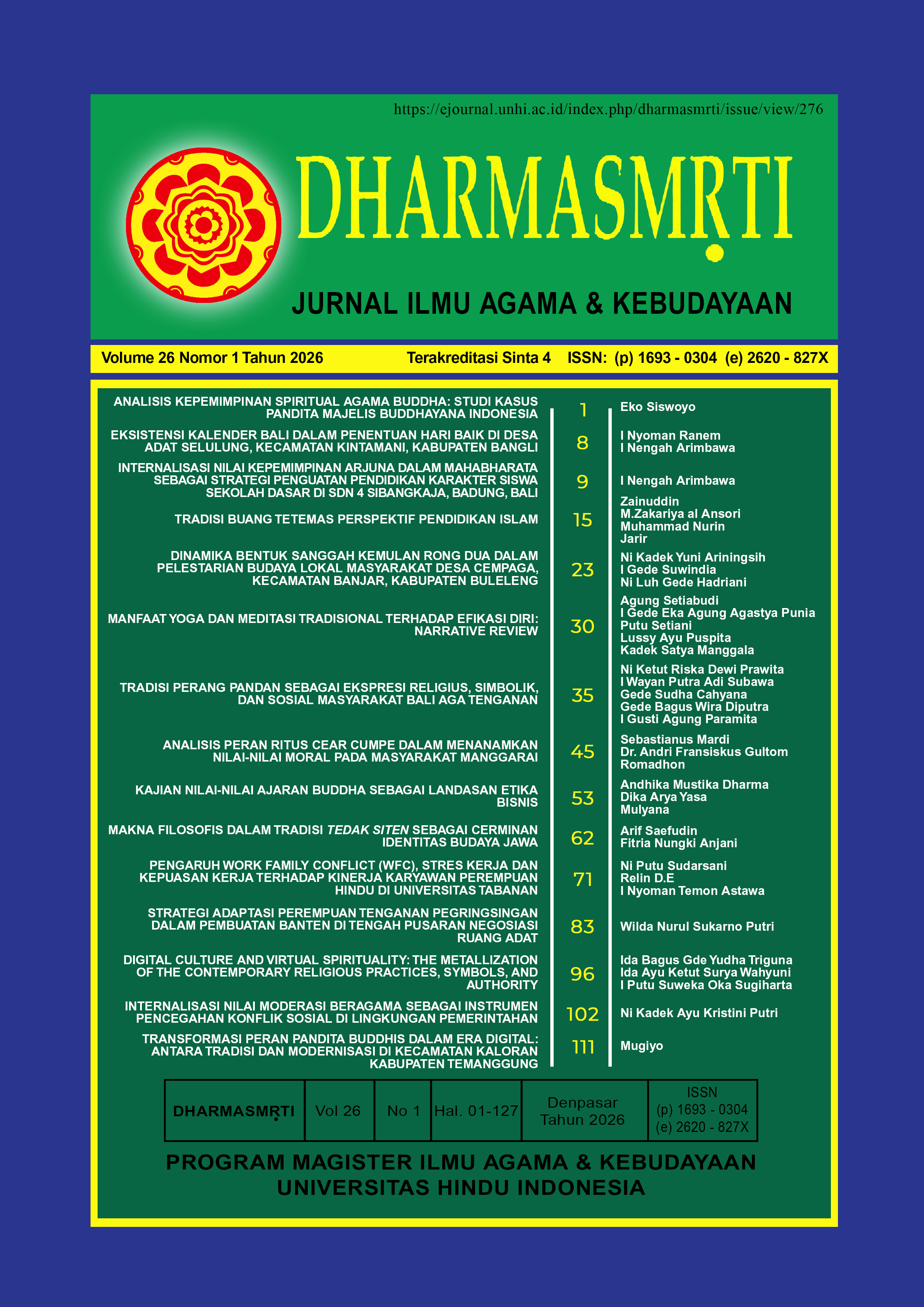
DIGITAL CULTURE AND VIRTUAL SPIRITUALITY: THE METALLIZATION OF THE CONTEMPORARY RELIGIOUS PRACTICES, SYMBOLS, AND AUTHORITY
DOI:
https://doi.org/10.32795/cm9aya34Keywords:
digital culture; virtual spirituality; digital religion; sacred symbols; religious authorityAbstract
In contemporary society, digital culture has played a major role in transforming how people experience and express spirituality. The advent of online faith communities, virtual rituals, and digital preaching hints that religious experience is no longer exclusively reliant on local sacred spaces or established institutional authority. This article studies the phenomenology of virtual spirituality in complex digital culture by analyzing the novel transformations of agency, orders of authority, sacred-symbol systems, and affective religious experience. Using qualitative-analytical methods guided by a thorough literature review, supplemented by select secondary empirical studies, this analysis integrates the sociology of religion, symbolic anthropology, and digital religion studies. Four findings are central: (1) networked faith communities function as infrastructures of psychosocial-spiritual support, (2) digital ritual-devotional practice that reconfigure sacred presence mediations, (3) hybrid religious authority emerging from platform visibility-interaction, (4) recontextualization of sacred symbols through remediation-personalization in a "spiritual marketplace." These findings imply that virtual spirituality is not simply a technological adaptation and signal an ontological change in the production and negotiation of sacrality in digital ecologies.
Downloads