| WIDYA KESEHATAN |
|
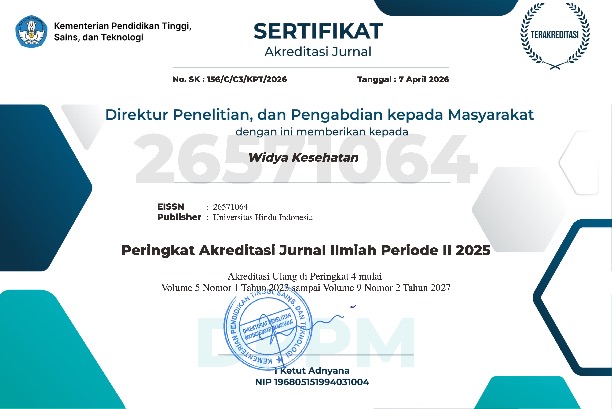
Widya Kesehatan Journal is a scientific publication that undergoes a peer-review process and focuses on disseminating academic contributions in the field of complementary traditional medicine. The journal places particular emphasis on Ayurvedic health and traditional Balinese medicine systems. The journal is published biannually, with two issues per year (May and October editions). Presently, the Widya Kesehatan Journal has been accredited at SINTA 4 by the Director of Research and Community Service at the Ministry of Higher Education, Science, and Technology, for issues ranging from Volume 5, Issue 1, 2023, to Volume 9, Issue 2, 2027.
|
| CITATIONS IN SCOPUS DATABASE |
 Citation Metrics Citation Metrics38
Total Citations
17
Indexed Articles
Last updated: July 2026. Citation data provided by Scopus® database. |
| SCOPUS INDEXED ARTICLES |
|
| TEMPLATE |
 |
| ABOUT JOURNAL |
| FOCUS AND SCOPE |
| SUBMISSIONS |
| AUTHOR GUIDELINES |
| COPYRIGHT AND LICENSE STATEMENT |
| AUTHOR FEES |
| PEER REVIEWERS |
| OPEN ACCESS POLICY |
| PUBLICATION ETHICS |
| INDEXED AND LISTED BY |
          |
| RECOMMENDED SOFTWARE |
 |
| JOURNAL VISITORS |
| |
| KEYWORDS |
Submissions
Author Guidelines
The following guidelines have been established to assist authors in preparing journal manuscripts for Widya Kesehatan.
- Journal manuscripts may take various forms, including research results, graduate articles, literature reviews, and case reports. It is important to note that these manuscripts may not have been previously published.
- Manuscripts may be submitted in either Indonesian or English. Each article is expected to range from 10 to 15 pages in length, inclusive of tables and figures such as photographs, charts, maps, graphs, histograms, sketches, or diagrams.
- The abstract must be written in both the Indonesian and English languages, with a maximum length of 250 words. In the event that the manuscript is written in Indonesian, the abstract must be written first in Indonesian, followed by the abstract in English in italics, and vice versa.
Subsequent to composing the abstract, it is imperative to incorporate a maximum of five keywords. - The author's name, omitting academic titles and institutional addresses, must be written in full.
- The following guidelines must be observed when drafting the manuscript:
- The program is entitled: Microsoft Windows is a proprietary operating system developed by Microsoft (.doc/docx/dot)
- The typeface employed is as follows: The font size is set to 12 points in the Times New Roman typeface
- The abstract must be written in italics with single spacing.
- The content of the publication or manuscript must be written in regular font with 1.5 spacing.
- References are to be written in regular font with single spacing.
- Margins: left 3.5 centimeters; right, top, and bottom 3 centimeters each, with paper size A4.
- The writing format is as follows: (a) The original research manuscript under consideration comprises the following elements: The following components are required: title, author's name, author's address, abstract, introduction, research methods, results and discussion, conclusion, suggestions and acknowledgements (if applicable), and references. (b) The literature review manuscript under consideration comprises the following elements: The following elements are required: title, author's name, abstract, and introduction. The following components are to be included: discussion, conclusion, suggestions, acknowledgments (if applicable), and bibliography. When quoting the opinions of others, it is essential to cite the author's name and the year of publication.
- The bibliography is arranged in alphabetical order by author's name, excluding serial numbers. The following example illustrates the composition of a bibliography:
Book
Mahadevan, L. 2012. Ayurveda For Beginners. Chennai: Mani Offset.Article in a book (chapter in a book)
Myers, N. 1995. Tropical Deporestration: Population, Poverty and Biodiversity. In: Swanson. T.M. (ed.). The Economic and Ecology of Biodiversity Decline. UK. Cambridge University Press.Journal
McGuinness, K.A. 1997. Seed Predation in a Tropical Mangrove Forest: a test of The Dominance-Predation Model in Northern Australia. Journal of Tropical Ecology 13: 293:302.Proceedings
Pathak, Yaswant. 2017. Nanotechnology Applications In Delivering Ayurvedic Drug Curcumin & Natural Compounds For Better Effectiveness And Its Economic Impact. Proceedings of the International Seminar “The Concept Of Healing In Religion, Culture, Health Sciences And The Economical Prospective.” Hindu Indonesia University. Denpasar. pp. 1–12.Thesis, dissertation, or dissertation
Prastika, I Nyoman. 2017. Yoga Sastra Laku Mistik Balian Usada Di Bali. (Dissertation). Hindu Indonesia University. Denpasar.
- Each graph, histogram, sketch, and image must be numbered sequentially, given a brief but clear title, and include the units used.
- Results already written in tables do not need to be repeated in another form (graph or histogram).
Privacy Statement
The names and email addresses entered in this journal site will be used exclusively for the stated purposes of this journal and will not be made available for any other purpose or to any other party.